
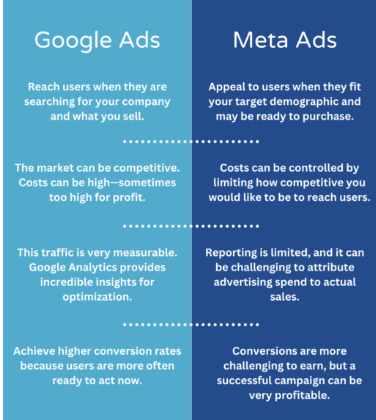
In today’s competitive digital marketing landscape, two giants dominate the paid advertising space: Google Ads and Meta Ads (formerly Facebook Ads). While both platforms offer powerful tools to reach your audience, they operate in very different ways, and choosing the right one can dramatically impact your ROI.
So, which is better for your business: Google Ads or Meta Ads?
Let’s break down their strengths, differences, and when you should use one (or both).
What Are Google Ads?
Google Ads is a pay-per-click (PPC) advertising platform where you bid to have your ads appear on Google’s search results, YouTube, Gmail, and across the Google Display Network.
Google Ads is intent-driven: it shows your ads to people who are actively searching for something related to your product or service.
Key Formats:
- Search Ads (text ads on Google)
- Display Ads (image/banner ads on websites)
- Shopping Ads (product listings)
- Video Ads (YouTube)
- App Promotion Ads
What Are Meta Ads?
Meta Ads allows you to run targeted campaigns across Facebook, Instagram, Messenger, and the Audience Network.
Unlike Google Ads, Meta Ads are discovery-based. You’re targeting users based on their demographics, interests, and behavior, not necessarily what they’re currently searching for.
Key Formats:
- Image & Video Ads
- Carousel Ads
- Stories & Reels Ads
- Lead Generation Forms
- Dynamic Product Ads
⚖️ Google Ads vs. Meta Ads: Side-by-Side Comparison
| Feature | Google Ads | Meta Ads |
|---|---|---|
| User Intent | High (search-driven) | Low to medium (interest-driven) |
| Audience Targeting | Keyword and intent targeting | Interest, behavior, lookalikes, custom lists |
| Best For | Capturing demand | Creating and nurturing demand |
| Ad Placement | Search results, websites, YouTube | Facebook, Instagram, Messenger, Audience Net |
| Cost Per Click (CPC) | Typically higher | Generally lower |
| Visual Creativity | Limited in search, strong in YouTube | Very strong with visual storytelling |
| Speed to ROI | Quick for high-intent searches | Slower, but great for awareness and retargeting |
| Sales Funnel Stage | Bottom (conversion-focused) | Top and mid-funnel (awareness & engagement) |
🛒 When to Use Google Ads
- You sell a product or service that people are actively searching for.
- You want fast, conversion-driven results.
- Your offer solves an urgent problem (e.g., “emergency plumber”).
- You’re targeting high-intent keywords like “buy,” “book,” “near me.”
- You have a limited creative budget and need a text-driven approach.
Great for: eCommerce, local services, B2B SaaS, lead generation with clear search demand.
📣 When to Use Meta Ads
- You want to build brand awareness and grow a following.
- You have strong creative assets (images, videos, lifestyle content).
- Your product requires education or storytelling before purchase.
- You’re promoting impulse-buy products or lifestyle brands.
- You want to build a remarketing audience for future campaigns.
Great for: DTC brands, subscription services, event promotions, mobile apps, lead nurturing.
🚀 The Power of Using Both
The truth is: Google Ads and Meta Ads work better together than in isolation.
Here’s how to combine them for best results:
- Drive awareness with Meta Ads through engaging visual content.
- Retarget website visitors on Meta who didn’t convert from Google.
- Capture bottom-funnel demand with Google Search Ads.
- Use Meta lookalike audiences based on Google Ads converters.
- Reinforce brand credibility by appearing on both platforms consistently.
💡 Final Thoughts
If you’re choosing between Google Ads and Meta Ads, it’s not a question of which is better—but which is better for your goals.
- Need immediate leads or sales from people searching now? Go with Google Ads.
- Want to build awareness, nurture prospects, or reach people who don’t know you yet? Try Meta Ads.


