

How Search Engines Work: Crawling, Indexing, and Ranking Explained
Ever wonder how Google seems to know exactly what you’re looking for, within milliseconds? The magic lies in how search engines crawl, index, and rank content across billions of web pages.
If you’re a business owner, content creator, or digital marketer, understanding how search engines work is crucial to improving your online visibility and reaching your target audience.
Let’s break it down step by step.
Step 1: Crawling – How Search Engines Discover Content
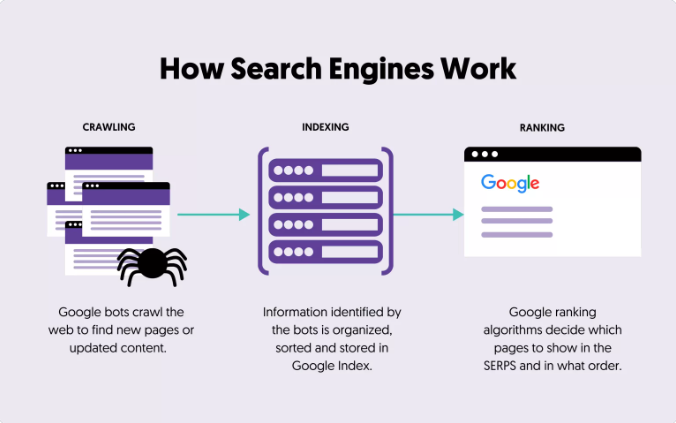
Crawling is the first step in the search engine process. Search engines send out software bots—called crawlers or spiders—to explore the web. These bots follow links from one page to another, constantly scanning the internet for new and updated content.
What Do Crawlers Look For?
-
New pages or websites
-
Changes or updates to existing pages
-
Links to other pages (internal and external)
-
Blocked pages (via robots.txt or noindex tags)
Think of crawling as a librarian scanning new books to decide whether they should be added to the library.
Tip for SEO:
Make sure your site has a clean structure, internal linking, and isn’t blocking crawlers from key pages. Use tools like Google Search Console to see how your site is being crawled.
Step 2: Indexing – How Content Is Stored and Organized
Once a crawler visits your page, the next step is indexing. This is when your content is analyzed, categorized, and stored in the search engine’s massive database—called the index.
What Gets Indexed?
Search engines try to understand:
-
What the page is about (using content, keywords, titles, headers)
-
The type of content (text, images, video)
-
Context (semantic relevance, topic clusters)
-
Mobile-friendliness and loading speed
If a page is deemed valuable and crawlable, it gets added to the index. If not—because of duplicate content, poor quality, or blocked access—it might be excluded.
Tip for SEO:
Use descriptive title tags, meta descriptions, header tags, and alt text. Ensure your content is original, valuable, and easy to read.
Step 3: Ranking – How Pages Are Ordered in Search Results
After your page is indexed, the final step is ranking—deciding where your page appears in the search results for a specific query.
Google uses a complex algorithm with hundreds of ranking factors, but the main goal is to provide the most relevant, useful, and trustworthy content to the user.
Key Ranking Factors Include:
-
Relevance to the search query
-
Content quality and depth
-
Backlinks (links from other reputable sites)
-
Page experience (mobile usability, site speed)
-
Domain authority and credibility
-
Search intent match (informational, navigational, transactional)
Tip for SEO:
Understand the search intent behind keywords. Create high-quality, user-focused content, and earn authoritative backlinks to improve your rankings.
TL;DR: The Search Engine Process Simplified
-
Crawl – Bots scan your site and follow links.
-
Index – Content is stored and categorized.
-
Rank – Your page is scored and placed in search results based on relevance and authority.
Why This Matters for Your SEO Strategy
If you want your website to appear in search results:
-
Ensure your site is crawlable.
-
Provide high-quality, indexable content.
-
Align your content with what users are actually searching for.
Mastering these three pillars of search engine function will set the foundation for SEO success in 2025 and beyond.


